Oh Hell, We’re Where?
musings on dead-ends, gorges and writing yourself free

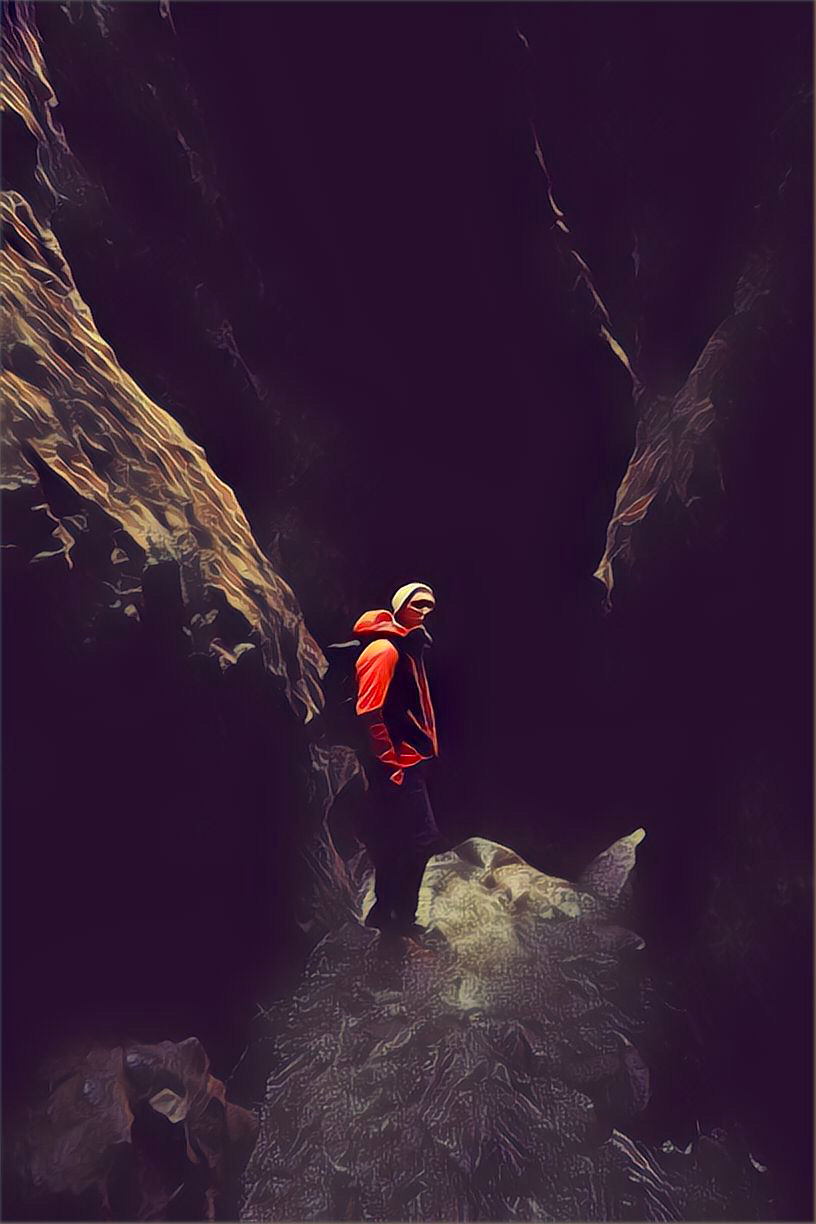
Year Nine school camp took us to Apollo Bay/Ottway Ranges (along the Great Ocean Road in Victoria) for four nights. An identical camp had been running for years: two nights by the beach in Apollo Bay; two nights roughing it in the bush, sleeping under bivvies in preparation for Outward Bound the following year.
Our group started with the roughing it bit and were dropped off, with our backpacks, to hike down into the camping area by the river.
Miss Dorman, our PE teacher, told us we were taking a slightly different route to other years, but it wouldn’t be much longer: two hours tops! One hour went by, followed by another, then another. As the afternoon air cooled on our shoulders and our backpacks bent our tender unprepared backs, it became apparent we were just a little bit lost.
We were told it was okay—the gorge ahead was where we were headed
Just on sunset, we emerged from the bush, at the edge of the gorge, several kilometres away from where we were meant to be, too close to the coast and without a trail down.
Gorge vs Dead End
Sometimes we emerge from the wilderness of our words to find we’re not exactly where we’re meant to be. The story takes a tiny deviation, the characters insist on going this way rather than that way and suddenly we’re in a whole (hole?) new place.
That night back in 1988 we weren’t at a dead-end. We’d simply arrived at a place which was much harder than anticipated to traverse. We hung tight and waited for morning.
What if we considered our plot impasses as arriving where the divide between where we are and where we want/need to be is bigger than we anticipated. Instead of a dead-end, we stand on the edge of the narrative gorge. Rather than back track (like we’d have to if we were dealing with a dead-end) we scout a different route down and through.
A Light to Illuminate the Way
We had no way of communicating our location or the fact we were all fine. It was years before any of us would see a mobile phone, much less own one. When night fell, the sky above the gorge erupted into a sea of stars, freed from the light pollution of the city. Below, on the beach, emergency beacons sprung to life.
Seeing those beacons, gave me the fortitude to make the best of our less than salubrious circumstances. Someone and something was out there. And tomorrow night, we’d be back where we were meant to be.
The following exercise is the light to give you fortitude to keep going. It will support you to get off the edge and safely down into the gorge and out the other side. It works for an impasse in an existing WIP and can also be used to explore a new idea if you’re unsure the direction to take it.
The Point of View of Three
This process below is based on an exercise I learned from author Trent Jamieson in a 2008 workshop. As an editor, I’ve given it to writers stuck in a first drafts and as a writer I’ve used it to gestate ideas beyond the obvious story trajectory.
First
Think of a short scene, any scene you can dream up. The only caveat is you cannot use the scene you are stuck in.
In this scene:
1) something happens,
2) at least two people must be involved
Second
Write 250 words from the point of view one of the characters. It must be in the first person PoV, present tense.
Third
Write the same scene but from the point of view of a different character. This version must be in limited third person PoV, present tense.
Lastly
The final version of the scene is written from the point of view of someone not participating in the scene ie. someone witnessing what’s going on.
This can be written from the limited 3rd person or 1st person PoV but in the past tense.
Who are they? Why are they there? What can they see that no one else can? How does this shift the narrative? What is possible now?
Happy Endings
That night in the Ottways we’d run out of water and eaten everything that didn’t require cooking. While we were all a little freaked out about being ‘momentarily lost’, we had warm sleeping bags and … George Michael.
Our friend Rachael had stuffed her battery-powered, pink twin-deck tape player in her backpack. “Essentials” is open to interpretation when you’re fourteen! “Faith” sung out through the pristine bush until the batteries finally ran out.
A few days later, we appeared on the front page of the Colac Times. The photo showed us dirty and bedraggled, but with smiles a mile wide as we walked out of the bush and back into the world we knew.
This missive comes to you from the traditional lands of the Turrbal and Yaggera people, Meeanjin (Brisbane, Australia) published on the day of Mars in the hour of Mercury.